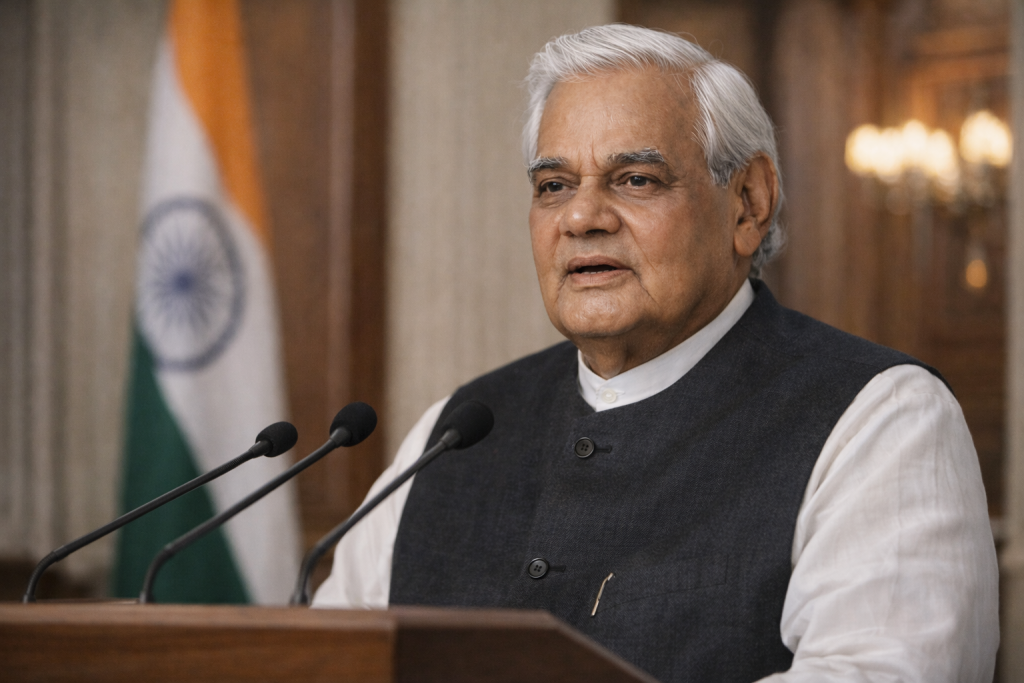
Historical Timeline

Political journey and leadership roles

1924

Born in Gwalior

Atal Bihari Vajpayee was born in Gwalior, Madhya Pradesh, in a disciplined family.

1957

Elected to Lok Sabha

He was elected to India’s Lok Sabha, marking the beginning of his political journey.

1996

Became Prime Minister of India

Vajpayee became India’s Prime Minister, demonstrating visionary leadership, diplomacy

1998–2004

Longest tenure as PM

Served as Prime Minister with historic reforms, infrastructure projects, economic growth.

1998

Pokhran-II Nuclear Tests

India conducted Pokhran-II nuclear tests, asserting strategic power, security, and international recognition

2015

Bharat Ratna Awarded

He received Bharat Ratna, India’s highest civilian honour, for extraordinary service and leadership.

2018

Passed away

Atal Bihari Vajpayee passed away peacefully, leaving behind an inspiring legacy for India forever.

Partition era activism

During the Partition of India in 1947, a young Atal Bihari Vajpayee actively participated in humanitarian and social work. He assisted refugees, organized relief camps, and promoted communal harmony amidst widespread violence and displacement. His efforts demonstrated courage, empathy, and a deep sense of responsibility toward his fellow citizens.

This early experience profoundly shaped Vajpayee’s commitment to peace, national unity, and public service. It laid the foundation for his future political career and statesmanship, reflecting values of compassion, integrity, and leadership that continued to guide him throughout his life.

Jansangh and BJP formation period

During the 1950s and 1980s, Atal Bihari Vajpayee played a pivotal role in India’s political landscape by shaping the Bharatiya Jana Sangh and later co-founding the Bharatiya Janata Party (BJP). As a young leader, he advocated for national development, democratic values, and social reform. Vajpayee’s eloquence and leadership helped the Jana Sangh grow into a respected political force. Later, he guided the formation of the BJP, emphasizing unity, ideological clarity, and mass outreach, laying the foundation for a strong, modern political party that would eventually shape India’s future governance.

His vision during this period focused on building a party rooted in ethical politics, national pride, and development-oriented governance. Through speeches, grassroots campaigns, and organizational work, Vajpayee inspired generations of leaders and supporters, setting a benchmark for principled political leadership. His role in these formative years was instrumental in establishing a lasting political legacy.

Prime Minister Tenures (1996, 1998–2004)

1996

Prime Minister Term

Atal Bihari Vajpayee first assumed office as India’s Prime Minister in May 1996, leading a minority government. Although his term lasted only 13 days, it marked a defining moment in Indian politics, showcasing his principled leadership and commitment to democratic values. Vajpayee chose to resign rather than compromise on political ethics for majority support. This short tenure earned him national admiration and strengthened his image as a leader of integrity, courage, and moral conviction.

1998–2004

Prime Minister Term

Vajpayee returned to power in 1998 and led India through one of its most transformative eras until 2004. His tenure witnessed landmark decisions such as the Pokhran-II nuclear tests, major economic reforms, and breakthrough diplomatic relations with global nations. He launched ambitious infrastructure projects including the Golden Quadrilateral and strengthened rural connectivity through development schemes. Known for stability, vision, and inclusive governance.

Historic National Milestones

1998

Pokhran-II Nuclear Tests

1999

Kargil War

1999

Golden Quadrilateral Project

2000

Economic Reforms

Scroll to Top

Pokhran-II Nuclear Tests

In May 1998, under the leadership of Prime Minister Atal Bihari Vajpayee, India successfully conducted the Pokhran-II nuclear tests in Rajasthan. This decisive and bold action positioned India as a global nuclear power and demonstrated the country’s strategic and scientific strength. Despite facing intense international pressure and economic sanctions from several nations, Vajpayee stood firm in defending India’s right to national security and sovereign decision-making. The tests were conducted secretly with exceptional coordination among scientists, the armed forces, and the government, symbolizing national unity and technological advancement

Pokhran-II redefined India’s role on the world stage, shifting geopolitical dynamics in South Asia and initiating a new era of diplomatic maturity. The achievement inspired national pride and showcased Vajpayee’s visionary leadership and unwavering commitment to protecting the country’s long-term security interests.

Kargil War

The Kargil War of 1999 marked a crucial moment in India’s defence history, testing the strength, resilience, and unity of the nation. Under Prime Minister Atal Bihari Vajpayee’s leadership, India responded firmly to the infiltration and military intrusion by Pakistani-backed forces along the Line of Control in the Kargil region of Jammu & Kashmir. Vajpayee emphasized a strategy rooted in military courage, diplomatic pressure, and ethical decision-making, earning global respect for India’s dignified conduct during the conflict.

Vajpayee’s decision to limit military action strictly to Indian territory demonstrated restraint and integrity, showcasing India as a responsible global power. The war reaffirmed national unity and strengthened the morale of the armed forces, establishing a legacy of courage and statesmanship that continues to inspire generations.

Golden Quadrilateral Project

The Golden Quadrilateral (GQ) highway project, initiated during Vajpayee’s tenure, became one of India’s most ambitious infrastructure achievements. Its purpose was to revolutionize national transportation by connecting the country’s four major metro cities—Delhi, Mumbai, Chennai, and Kolkata—through a modern highway network. Launched in 1999 with implementation beginning in 2001, the project played a transformative role in improving trade mobility, reducing travel time, supporting logistics and industry, and promoting regional economic development.

The Golden Quadrilateral strengthened India’s economic productivity and reshaped travel and commercial efficiency across states. By promoting connectivity between cities and rural regions, it opened new opportunities for industrial development and investment. The vision of linking the nation through world-class roads stands as one of Vajpayee’s most enduring contributions to India’s modernization.

Economic Reforms

During his tenure, Vajpayee introduced forward-looking economic reforms that reshaped India’s financial and development landscape. His government focused on liberalization, privatization, and global economic integration. Reforms in infrastructure, telecommunications, disinvestment, and finance laid the foundation for rapid economic progress and attracted international investment. One of the most important steps was the introduction of the Fiscal Responsibility and Budget Management (FRBM) Act, aimed at improving fiscal discipline, lowering deficits, and strengthening India’s financial stability.

These reforms promoted entrepreneurship, technological growth, and improved business conditions across the country. By opening India to global markets and strengthening internal systems, Vajpayee prepared the nation for the economic expansion that followed in later decades. His policies created an environment of stability, growth, and innovation—redefining India’s economic direction and global identity.